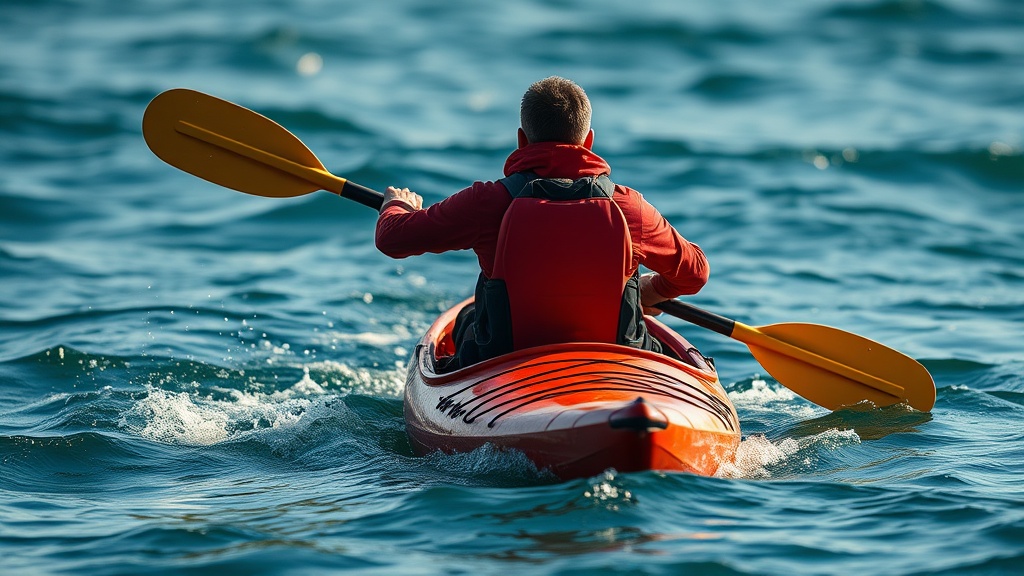
Building Core Stability for Heavy Sea Kayak Maneuvers
Most paddlers think core strength is about having visible six-pack abs or being able to hold a plank for three minutes. That's a mistake. In heavy sea kayaking, core stability isn't about aesthetics; it's about the ability to transfer power from your paddle blade through your torso to the hull of the boat. This post covers how to develop functional stability for heavy-water maneuvers, the specific muscle groups you actually need to train, and how to move from static strength to dynamic stability in a moving sea state.
If you're paddling a heavy sea kayak—the kind of boat that sits deep in the water and carries significant momentum—you can't just rely on your arms. When you hit a breaking wave or a heavy swell, your upper body needs to act as a rigid but responsive bridge. Without that stability, your strokes become inefficient, and your fatigue sets in much faster.
How Do You Build Core Stability for Sea Kayaking?
You build core stability for sea kayaking by focusing on rotational strength and anti-rotational movements rather than just traditional sit-ups. While a standard crunch works the rectus abdominis, it doesn't prepare you for the off-axis forces you feel when a swell hits the side of your hull. You need to train the obliques and the deep stabilizers like the multifidus and transverse abdominis.
Think about a heavy swell hitting your bow. If your core is "soft," your upper body will wobble independently of your hips. This creates a disconnect. You'll find yourself fighting the boat instead of moving with it. To prevent this, you need to incorporate movements that challenge your ability to resist rotation. Exercises like the "Pallof Press" are far more effective for a paddler than a thousand crunches ever will be.
Here is a breakdown of the three types of stability you need to develop:
- Anti-Rotation: The ability to stay upright and centered when a force (like a wave or a crosswind) tries to twist your torso.
- Rotational Power: The ability to rotate your torso efficiently during a powerful draw stroke or a heavy sweep.
- Dynamic Stability: The ability to maintain control while your center of mass is constantly shifting due to the movement of the water.
I've found that even when I'm training on land, using a Balance Board can help prime the neurological pathways for that constant micro-adjustment we do in the cockpit. It’s not just about muscle; it's about proprioception—knowing where your body is in space without looking.
What Are the Best Exercises for Paddling Strength?
The best exercises for paddling strength are those that integrate the hips, core, and upper back into a single functional unit. You aren't just lifting weights; you're teaching your body to move as one-piece machine. If you only train isolated muscles, you'll feel "stiff" in the boat, which is the last thing you want when a big wave is coming your way.
I usually suggest a mix of heavy compound lifts and high-frequency stability work. For example, a deadlift builds that foundational posterior chain strength, but a single-arm kettlebell swing builds the much more specific stability required for a heavy sea kayak. The asymmetry of the kettlebell forces your core to fight against a shifting load—much like a heavy paddle stroke in a crosswind.
The "Big Three" for Sea Kayakers:
| Exercise Type | Targeted Benefit | Example Movement |
|---|---|---|
| Anti-Rotation | Prevents unwanted twisting in heavy seas | Pallof Press or Single-Arm Farmer's Carry |
| Rotational Power | Increases stroke efficiency/force | Medicine Ball Rotational Throws |
| Posterior Chain | Supports posture during long sessions | Deadlifts or Kettlebell Swings |
Don't overlook the importance of the back muscles. A strong core is useless if your upper back is a weak link. If your upper back collapses, your breathing becomes shallow and your stroke loses its power. A study on muscle recruitment patterns suggests that much of the stability we rely on actually comes from the integration of the thoracic spine and the core. If your back is tight, your core can't do its job.
One thing to keep in mind: don't overdo the heavy lifting right before a big trip. You want to be strong, not sore. If you walk into a heavy sea state with a bruised core, you're going to have a bad time. (And trust me, a sore core makes every brace feel twice as hard.)
Why Is Core Strength Important for Heavy Water?
Core strength is important for heavy water because it dictates how much of your energy actually reaches the water. In a heavy sea kayak, the boat has significant mass. To turn that mass, you have to move a lot of weight. If your core is weak, that energy is lost in your midsection, and your turns become sluggish and imprecise.
When you're out in the swell, the water is constantly trying to throw you off balance. You're not just sitting in a static seat; you're balancing on a moving platform. This requires constant, micro-adjustments. A strong core allows you to stay "connected" to the boat. This connection is what allows you to execute a high-angle brace or a powerful heavy-water turn without losing your center.
It's also about safety. When things go sideways—literally—your core stability is what helps you maintain an upright posture during a brace. If you can't stabilize your torso, you're much more likely to lose your balance and end up in the water. It's a basic matter of physics: a stable center of gravity keeps you in the cockpit.
Think about the way a professional athlete moves. They aren't just "strong"—they're controlled. That control is what you're aiming for. You want to be able to react to a rogue wave or a sudden gust of wind with a decisive, controlled movement, not a panicked scramble. That's the difference between a controlled maneuver and a total wipeout.
I often see people focus way too much on their arms. They'll buy the most expensive carbon fiber paddle on the market, but they haven't trained the muscles that actually drive the paddle. It's a waste of gear. The paddle is just an extension of your body. If the body is weak, the paddle won't save you. The real "gear" is your own musculoskeletal system.
One final tip for your training: work on your endurance, too. A heavy sea kayak session can last hours. It's not just about a single burst of strength; it's about maintaining that stability for the long haul. If your core fatigues halfway through a trip, your technique will fall apart, and that's when mistakes happen. Incorporate some longer-duration stability work—like a long-duration plank or slow-tempo movements—to build that mental and physical stamina.