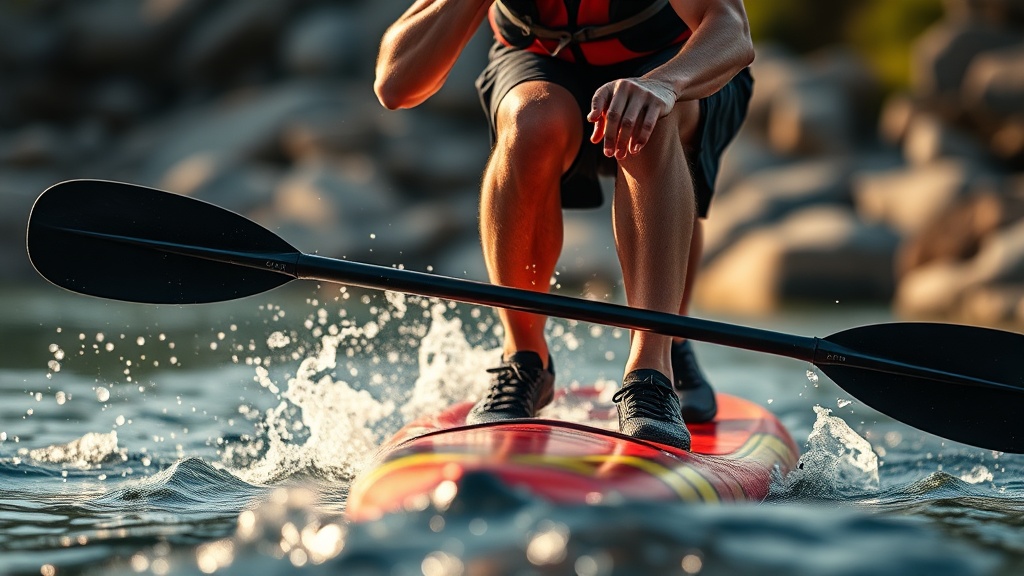
Building Durable Joints for High-Impact Paddle Sports

What makes a paddle athlete's joints wear down?
This guide covers the physiological requirements for maintaining joint integrity during high-impact paddle sports and provides specific strategies for structural durability. You'll learn how to manage mechanical stress on your shoulders, hips, and wrists so you can stay in the water longer without the nagging discomfort that often follows heavy sessions. Understanding how to build a body that resists wear and tear—rather than just one that performs well for a single session—is the difference between a long-term hobby and a short-lived obsession.
The repetitive, high-torque nature of paddle sports puts specific demands on your connective tissues. Whether you're carving a wave in a surf kayak or battling a heavy current, your joints act as the hinges for much of your power. If those hinges aren't supported by stable musculature and resilient ligaments, you'll start feeling the impact in your elbows and lower back. We're looking at ways to strengthen the surrounding structures to protect the actual joint surfaces.
A lot of people focus purely on muscle size or explosive power, but they forget that muscles are the shock absorbers for the joints. If your muscles fatigue, the load shifts directly to your tendons and ligaments. This is where many athletes see their progress stall. By focusing on stability and eccentric control, you're essentially building a better suspension system for your body.
How do I strengthen my shoulders for heavy paddle sessions?
The shoulder is a highly mobile but inherently unstable joint. For anyone in the paddle sports world, the rotator cuff is the most vulnerable part of the kinetic chain. To protect it, you shouldn't just do heavy presses; you need to focus on stability and deceleration. When you're finishing a powerful stroke, your muscles have to work to stop the motion—that's an eccentric load. If you can't control that deceleration, you're putting way too much stress on the shoulder capsule.
Try incorporating movements that emphasize slow, controlled movements under tension. Think about lateral raises with a very controlled descent or face pulls that focus on the rear deltoid and middle trapezius. These movements help stabilize the scapula (your shoulder blade), which serves as the foundation for all your upper body power. A stable scapula means a stable shoulder. Without it, you're just asking for impingement issues.
It's also worth noting the importance of thoracic mobility. If your upper back is stiff, your shoulders have to compensate with more movement to reach your paddle. This extra range of motion isn't coming from the joint itself, but from the surrounding tissue being stretched too far. A more mobile thoracic spine actually makes your shoulders more resilient. You can find great anatomical breakdowns of these movements on sites like Physiopedia to ensure your form is correct.
Can I improve my wrist and elbow durability?
Wrist fatigue is a common complaint among paddlers, often leading to tendonitis or general discomfort during long sessions. This usually stems from a lack of grip stability and poor forearm strength. Instead of just training heavy grip strength, focus on the dexterity and endurance of your wrists. This involves working through various planes of motion—flexion, extension, and rotation—to ensure the tendons are conditioned for the varied angles of a paddle stroke.
- Wrist Stability: Practice holding a paddle or a weighted bar in different positions to build stability.
- Forearm Endurance: Use lighter weights with higher repetitions to build the endurance needed for long-distance sessions.
- Rotational Control: Work on controlled rotations to mimic the torque of a paddle stroke.
The elbow often suffers when the forearm muscles are weak or tight. If your forearm muscles are perpetually tight, they pull on the tendons at the elbow, leading to common issues like tennis or golfer's elbow. Regular stretching and myofascial release (using a lacrosse ball or your hands) can help keep these tissues pliable. Keeping your gear in good repair—like ensuring your paddle grip isn't too thin or too hard—can also reduce the direct impact on your hands and wrists.
How do I protect my lower body during high-impact moves?
While paddling is primarily an upper-body activity, your lower body provides the platform for all your power. Your hips and core are the bridge between your paddle and the water. If your core is weak, you'll see that instability translate into the lower back or even the hips. Strengthening the pelvic floor and the deep core muscles (like the transverse abdominis) helps create a solid foundation for every stroke.
For those who spend a lot of time in a seated position, hip mobility is a major concern. Tight hip flexors can pull the pelvis out of alignment, leading to lower back pain during long sessions. Integrating dynamic stretches like the world's greatest stretch or deep lunges can help maintain a healthy range of motion. We also want to be mindful of the environments we play in. When we're out in nature, we should aim for low-impact movement wherever possible to respect the environments we love. This means being conscious of how we land, how we move through sensitive areas, and ensuring our physical presence doesn't leave a lasting negative impact on the terrain.
Training for durability isn't about one single workout; it's about a consistent approach to how you treat your body. You might find that a more structured approach to strength training—one that emphasizes the eccentric phase and stability—yields better results than just chasing heavy weights. This isn't just about being able to pull harder; it's about being able to pull for a longer period of time without the structure failing.
As you get more advanced, you might want to look into more specialized training methods. For example, studying the biomechanics of the human body can provide a deeper understanding of why certain movements feel better than others. Resources like the Strength Level database can help you track your progress and see how your strength compares to others in similar disciplines. Just remember that strength is only one part of the equation—mobility and stability are the real keys to longevity.
Ultimately, the goal is to stay out on the water. Whether you're chasing the perfect wave or exploring a new river, your body is your most important piece of gear. Treat it with the respect it deserves by prioritizing the structural integrity of your joints. This approach will allow you to enjoy the outdoors for decades, rather than just a few seasons.