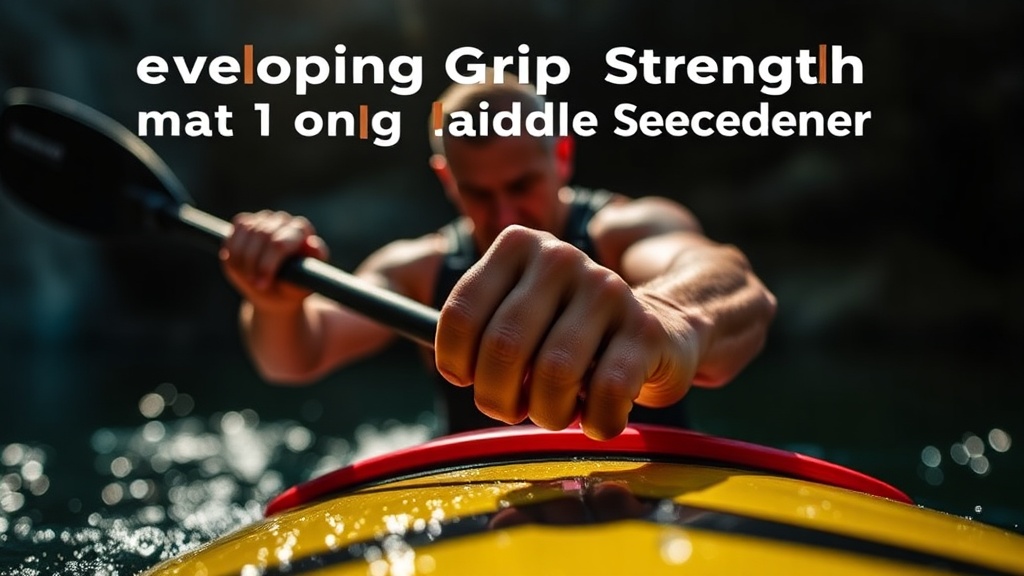
Developing Grip Strength for Long Paddle Sessions

Why Grip Strength Dictates Your Performance in the Water
Imagine you're halfway through a heavy swell session. Your shoulders feel fine, your core is stable, and your breathing is rhythmic—but then, your fingers start to cramp. The paddle feels like it's slipping, and despite your best efforts, you can't maintain a firm hold on the shaft. This isn't a shoulder problem; it's a hand and forearm issue. Grip strength is often the first thing to fail during high-intensity sessions, and when it goes, your ability to control your movements and react to wave changes vanishes. This post covers how to build functional hand and forearm power so your gear stays under control when the water gets rough.
A weak grip doesn't just make you less efficient; it actually forces your larger muscle groups to work harder to compensate for the lack of stability. If you can't hold the paddle securely, you'll likely overcompensate with your wrists or arms, leading to unnecessary tension. By the time you're heading back to the shore, you'll feel that dull ache in your forearms that makes even holding a water bottle difficult. We're going to look at how to prevent that through specific training and better technique.
How can I build forearm endurance for paddling?
To build endurance, you need to move beyond simple lifting and focus on time under tension. In the context of kayak surfing, you aren't just holding a static weight; you're managing dynamic, shifting forces. To train for this, incorporate exercises that involve both crushing grip (squeezing) and support grip (holding a weight for a long duration).
- Farmer's Carries: Grab two heavy dumbbells or kettlebells and walk with a straight back. This builds the foundational strength needed to hold a paddle during long paddle-outs.
- Dead Hangs: Find a pull-up bar and simply hang. Try to increase your time by five seconds every week. This builds the tendon strength required for sustained sessions.
- Towel Pull-ups: Drape a towel over a bar and hold onto the fabric while performing pull-ups or just hanging. This mimics the uneven, non-rigid feel of a paddle shaft.
If you want to see the physiological side of how muscles fatigue under tension, the Healthline resources on muscle fatigue provide great context for why these breaks happen. You aren't just losing strength; your nervous system is struggling to maintain the signal to those small muscles.
What is the best way to train my grip for sports?
The best way to train is to treat your hands like any other part of your kinetic chain. Don't just do random finger exercises; use tools that provide resistance. A hand gripper is a decent starting point, but it's a bit one-dimensional. For more functional strength, I recommend using a thick bar or a "fat grip" attachment on your gym equipment. A thicker grip forces your hands to work harder to stabilize the weight, which is much closer to the sensation of a wide-diameter paddle.
Don't neglect the extensors—the muscles that open your hand. Most people focus entirely on the squeeze (the flexors), but if you don't train the muscles that open the hand, you'll end up with incredibly tight, cramped forearms. Grab a thick rubber band, place it around your fingers, and practice expanding your hand against the resistance. This balance is what keeps your hands from feeling like frozen claws after an hour on the water.
Does grip strength impact my paddle control?
Absolutely. When your grip is weak, your paddle becomes a loose tool rather than an extension of your body. Think about the subtle adjustments you make to your edge or your stroke angle. If your hands are struggling just to stay attached to the shaft, those micro-adjustments become clunky and delayed. You lose the "feel" for the water.
A study on PubMed research often highlights the link between grip strength and overall physical stability. In kayaking, stability isn't just about your core; it's about the connection between your hands and the paddle. A strong, stable grip allows you to transfer the power from your torso into the water with much higher efficiency. If the connection is weak, power leaks out through your hands.
Try implementing these drills twice a week during your strength training sessions. You don't need to spend hours on this; even fifteen minutes of focused work can yield significant results over a few months. Just remember: consistency beats intensity. You're building tendons and ligaments here, which take longer to adapt than pure muscle tissue. Don't rush the process, or you'll risk tendonitis.
Another thing to watch for is the weight of your paddle. If you're using a heavier carbon fiber shaft versus a standard plastic or aluminum one, the demands on your grip will change. A heavier paddle might feel more stable in high winds, but it requires more constant muscular engagement. Train for the heaviest scenario you might encounter, and the lighter gear will feel like a breeze.