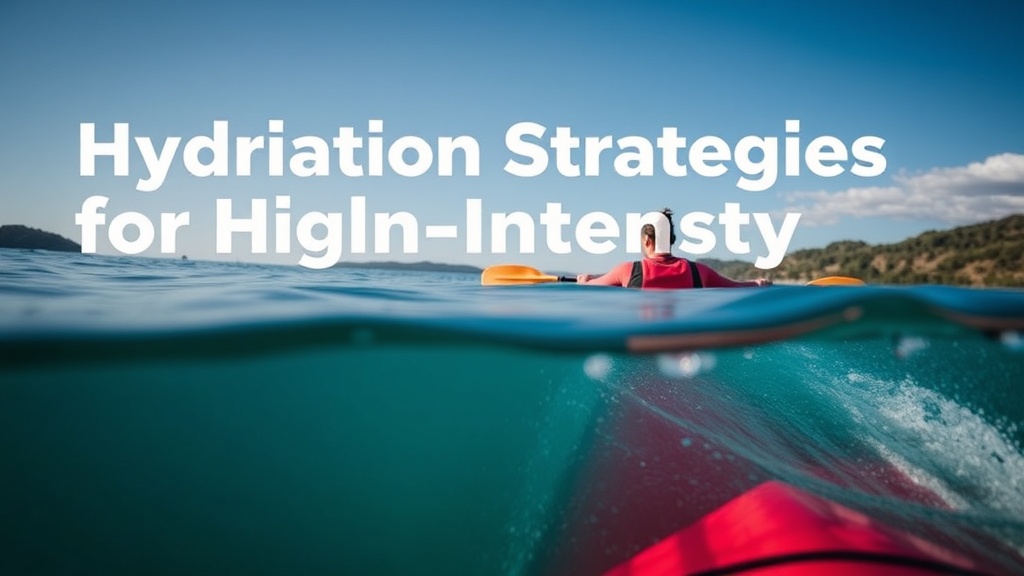
Hydration Strategies for High-Intensity Paddle Sessions

You'll learn how to manage your fluid intake, balance electrolytes, and time your drinking to prevent fatigue during intense paddle sessions. Staying hydrated isn't just about quenching thirst; it's about maintaining your cognitive focus and physical output when the waves get heavy. If you ignore your water needs, your performance will drop—often long before you actually feel thirsty.
Why does dehydration affect my paddling performance?
Dehydration directly reduces your blood volume, which makes your heart work harder to pump oxygen to your muscles. When you're out in a sea kayak, your body is fighting two battles: the physical exertion of the stroke and the thermal regulation required to keep your core temperature stable. Even a 2% drop in body weight from fluid loss can lead to diminished coordination and slower reaction times.
In a high-intensity environment, your brain needs to be sharp to read the water and react to incoming sets. If you're dehydrated, you might miss a subtle change in current or a swell pattern. That's a safety issue, not just a fitness one. You might find yourself feeling sluggish or experiencing muscle cramps—a common sign that your electrolyte balance is off.
It's worth noting that heat-induced fatigue is a real threat. Even on a cool, overcast day in the Great Lakes, the physical effort of paddling generates significant internal heat. You're sweating, even if you don't feel it because of the wind or water spray. If you don't replace that fluid, your endurance will crater.
To understand the science behind how water moves through your system, you can check out the principles of hydration on Wikipedia. It's a good baseline for understanding how cellular function relies on fluid levels.
How much water should I drink while paddling?
Most paddlers should aim for 500ml to 1 liter of fluid per hour during high-intensity sessions, depending on sweat rate and environmental temperature.
I find that using a hydration bladder, like those made by CamelBak, is much more effective than reaching for a water bottle. It allows for hands-free, micro-sips during a stroke cycle. You don't want to be fumbling with a bottle cap while navigating a heavy swell or a technical whitewater section.
The goal is to maintain a steady state. If you wait until you're parched, you've already lost the battle. Use these general guidelines for your session types:
- Low-Intensity/Flat Water: 400ml - 600ml per hour.
- High-Intensity/Surf/Ocean: 750ml - 1000ml per hour.
- Extreme Heat/High Humidity: 1000ml+ per hour (monitor for salt loss).
If you're also focusing on fueling your body for long-distance sessions, you'll need to combine this fluid intake with solid caloric intake to keep your energy from bottoming out.
What are the best electrolytes for saltwater environments?
The best electrolytes for intense paddling are a combination of sodium, potassium, magnesium, and calcium to replace what you lose through sweat. Saltwater environments often demand a higher sodium concentration because the heat and physical demand can lead to rapid fluid loss. Relying on plain water alone can actually be dangerous—it can lead to hyponatremia, where your sodium levels become too low.
I usually reach for products like Liquid I.V. or specialized electrolyte powders to add to my water. These are much more effective than standard sports drinks which can sometimes be too high in sugar and not enough in actual salts. You want a balance that supports muscle function and prevents cramping.
| Electrolyte | Primary Function | Deficiency Symptom |
|---|---|---|
| Sodium | Fluid retention & nerve signaling | Muscle cramps, dizziness |
| Potassium | Muscle contraction & heart rhythm | Muscle weakness, fatigue |
| Magnesium | Muscle relaxation & ATP production | Twitching, cramping |
| Calcium | Nerve transmission & muscle function | Spasms, fatigue |
The catch? Too much of any one thing can cause stomach upset. If you're out for a long day, don't just hammer electrolytes. Balance them with plain water to keep your system stable. It's a delicate act.
How can I track my hydration levels?
The simplest way to track your hydration is by monitoring the color and frequency of your urine. A pale, straw-colored urine indicates you're well-hydrated, while dark, amber-colored urine is a clear sign that you need to increase your intake immediately. This is a reliable, real-time metric that doesn't require any special equipment.
Another method is to weigh yourself before and after a long session. If you've lost significant weight, a large portion of that is likely water weight. This is a common way professional athletes track their physiological response to training. For us, it's a way to see how much we actually need to replenish.
Keep an eye on these physical cues as well:
- Dry mouth or sticky saliva: An early sign of thirst.
- Reduced skin elasticity: If you pinch the skin on the back of your hand and it stays "tented," you're dehydrated.
- Increased heart rate: If your heart is racing more than usual for the intensity level, you might be low on fluids.
- Headaches: Often a late-stage sign of dehydration and electrolyte depletion.
If you're noticing muscle fatigue or a lack of coordination, it might not just be your strength failing. It could be your hydration. It's worth checking your grip and core stability too—sometimes a loss of muscle control is actually a sign of systemic fatigue. If you're interested in that side of things, check out my post on developing grip strength to see how physical fatigue manifests in your hands and forearms.
The goal is to stay ahead of the curve. Don't wait for the warning signs to appear. By the time you feel the symptoms, your performance has already taken a hit. Plan your intake, use the right tools, and keep your focus on the water.