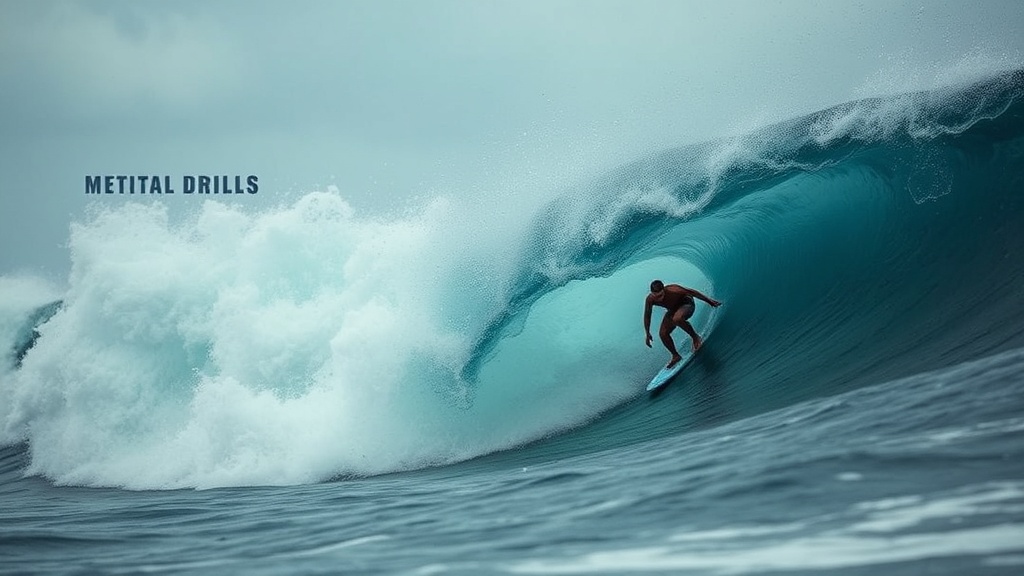
Mental Drills to Stay Focused in Heavy Surf

Box Breathing for Immediate Calm
Visualizing the Line Before the Set
Single-Point External Focus Techniques
The Reset Trigger Method
The ocean is a chaotic mess of white water, shifting currents, and unpredictable energy. When you're sitting in a heavy swell, the sheer volume of noise—both auditory and visual—can easily fracture your concentration. This post examines the mental drills used to maintain focus when the surf gets heavy, focusing on cognitive control, sensory regulation, and reaction time. Mastering these techniques helps you prevent panic and keep your paddle strokes precise when the stakes are high.
Staying focused in heavy surf requires more than just physical strength; it requires a disciplined mind. If your brain is racing faster than the waves, you've already lost the battle. You need to train your ability to filter out the noise and focus on the immediate task at hand.
How Can I Improve My Focus in Heavy Surf?
You can improve your focus by practicing sensory isolation and rhythmic breathing-based drills during calmer sessions. Most paddlers fail because they try to process everything at once—the wind, the spray, the sound of the breaking waves, and the movement of the boat. This leads to cognitive overload. Instead, you should train your brain to prioritize specific inputs.
One effective method is the "Anchor Point" technique. During a session, pick one specific visual marker—perhaps a buoy, a specific rock formation, or even a consistent part of your kayak's deck. When the swell picks up and things feel chaotic, force your eyes to lock onto that single point for a split second. This resets your visual field and prevents the "spinning" sensation that often precedes a panic response. It’s a way to find a center in the middle of the storm.
Another drill involves auditory compartmentalization. Heavy surf is loud. The roar of a breaking wave can be deafening. Instead of fighting the noise, try to categorize it. Distinguish between the low-frequency rumble of the swell and the high-frequency hiss of the whitewater. By categorizing the sounds, you turn an overwhelming sensory experience into a set of predictable data points. It’s a psychological way to stay grounded.
If you're feeling the physical strain of a long session, don't forget that physical fatigue often mimics mental fatigue. Check out my previous post on developing grip strength for long sessions, as a slipping paddle often leads to a loss of mental composure.
The Role of Breath in Cognitive Stability
Your breath is the bridge between your body and your brain. When the surf gets heavy, your breathing naturally becomes shallow and rapid. This is the body's fight-or-flight response. To combat this, use the Box Breathing method. This is the same technique used by high-performance athletes and even military personnel to maintain calm under extreme stress.
- Inhale: 4 seconds of deep, controlled air.
- Hold: 4 seconds of stillness.
- Exhale: 4 seconds of slow release.
- Hold: 4 seconds of empty lungs.
Doing this while paddling through a heavy swell might feel awkward at first, but it prevents the cortisol spikes that lead to poor decision-making. It keeps your heart rate in a manageable zone. It's not just about breathing; it's about controlling your nervous system.
What Are the Best Mental Drills for Reaction Time?
The best drills for reaction time involve predictive visualization and rhythmic repetition. You can't react to a wave if you're still processing the one that just passed. You need to be living one or two seconds into the future. This is a skill that can be trained in the water through intentional observation.
Try the "Wave Sequencing" drill. While waiting for a set, don't just sit there. Watch the horizon. Try to identify the difference between a peeling wave and a close-out wave before it reaches you. By predicting the outcome of the swell, you are training your brain to recognize patterns. This turns a "reaction" into a "response." A reaction is a reflex; a response is a calculated move.
Here is a breakdown of different mental states and how they affect your performance in heavy water:
| Mental State | Visual Focus | Physical Result | Risk Level |
|---|---|---|---|
| Reactive (Panic) | Darting eyes, wide-eyed | Rigid muscles, shallow breath | High (Capsize risk) |
| Observational (Flow) | Soft focus, tracking swell | Fluid movement, rhythmic | Low (Optimal) |
| Hyper-Focused (Tunnel) | Fixed on one point | Tense, high energy | Medium (Missed cues) |
A common mistake is falling into the "Hyper-Focused" state. While it feels intense, it actually limits your peripheral vision. If you stare too hard at one breaking wave, you might miss the swell coming from your blind side. You want to aim for the "Observational" state—where you see the whole picture without being overwhelmed by it.
Visualization: The Pre-Session Warmup
Mental training shouldn't only happen when you're actually in the water. True professionals do their work on the beach. Before you even touch your kayak, spend ten minutes visualizing the session. Imagine the heavy water hitting your hull. Imagine the feeling of a sudden drop in the swell. If you can visualize yourself successfully navigating a rough patch, your brain will recognize the pattern when it actually happens.
This isn't "positive thinking" in a vague sense. It's neurological priming. By running through the scenarios in your head, you reduce the novelty of the stressor. When the actual heavy surf hits, your brain thinks, "I've been here before," rather than "I'm in trouble."
How Much Mental Fatigue Affects Performance?
Mental fatigue significantly degrades your physical reaction time and decision-making capabilities. When your brain is tired, your body follows. You might feel like your arms are heavy, but often, the real culprit is a lack of neural drive. This is why many paddlers find themselves making silly mistakes or losing their line in the late stages of a session.
Research on cognitive fatigue suggests that as the brain exhausts its ability to maintain attention, the body's motor control decreases. For example, cognitive fatigue can lead to slower reaction times and decreased accuracy. In a kayak, this means a late paddle stroke or a poorly timed brace. You aren't just physically tired; you're mentally spent.
To prevent this, monitor your "internal weather." If you notice your thoughts becoming repetitive or your focus slipping, it's time for a tactical reset. This could be a few deep breaths, a quick sip of water, or even a moment of complete stillness. Don't wait until you're completely drained to take a break. It's much harder to recover from a mental slump than it is to prevent one.
If you find that your fatigue is mostly physical, you might need to look at your recovery. Proper sleep hygiene for muscle repair is a massive part of being able to sustain high-intensity sessions without the mental fog that follows physical exhaustion.
One thing to watch for is the "looping" thought. This is when you find yourself thinking about a mistake you just made—like a bad brace or a missed wave—over and over. This loop is a productivity killer. The moment you catch yourself looping, use a physical trigger to break it. A sharp exhale or a firm squeeze of the paddle shaft can pull you back into the present moment. It's a way to snap the tether and get back to the work.
The goal isn't to be a robot. You're in a dynamic, changing environment. You can't control the ocean, but you can control how much of it you let into your head. Practice these drills when the water is calm, so they become second nature when the swell turns heavy. That is the difference between just surviving the surf and actually riding it.