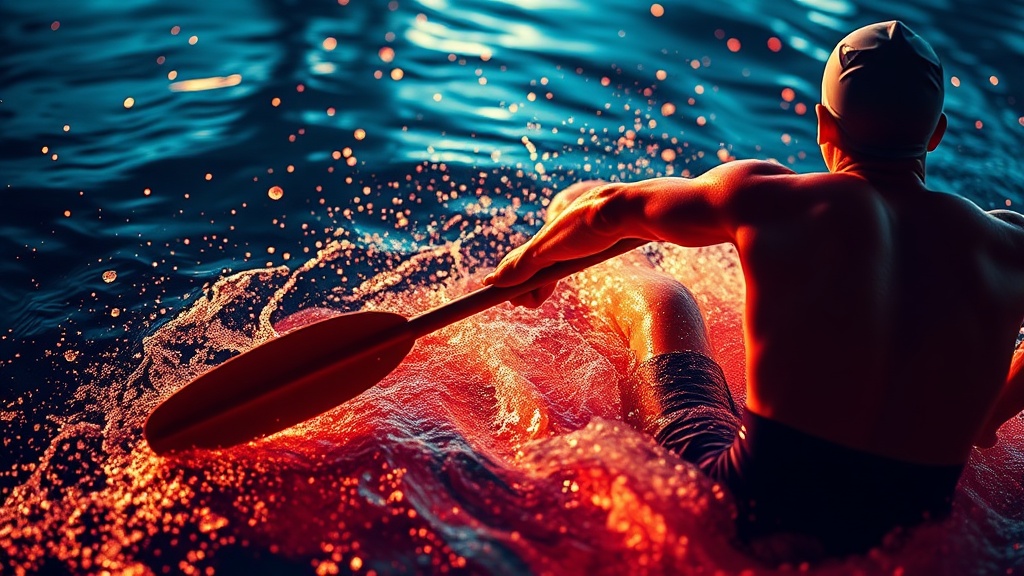
Improving Your Rotational Power for Faster Paddle Strokes
You'll learn how to increase your paddle stroke speed and efficiency by targeting the rotational mechanics of your core and torso. This guide focuses on the specific physical movements, exercises, and technical adjustments needed to move beyond arm-driven paddling and into true power-driven paddling. Developing this strength prevents shoulder fatigue and keeps you moving fast when the water gets heavy.
Why is Rotational Power Important for Kayaking?
Rotational power is the ability to transfer force from your feet through your core and into your paddle blade. Most beginners make the mistake of pulling with their arms, which leads to quick fatigue and potential shoulder injury. If you want to move a kayak through heavy whitewater or long-distance ocean swells, you need your large muscle groups—the obliques, lats, and transverse abdominis—to do the heavy lifting.
When you rotate your torso, you're using your entire body weight to drive the paddle. It's a much more efficient way to move water. Think about a professional rower or a baseball player; they don't just use their arms. They use their entire kinetic chain. If you're only using your biceps and triceps, you're going to hit a wall much sooner than if you use your core.
That said, you can't just "do more sit-ups" and expect to become a better paddler. You need functional, rotational strength. This means training your body to rotate under resistance while maintaining stability. Without that stability, you'll just be wiggling your spine rather than moving the boat.
How Do I Improve My Core Rotation for Paddling?
You improve rotational power by combining dynamic stability exercises with explosive, multi-planar movements. You need to train your body to stay stable while rotating, which is a high-level skill. A good place to start is with movements that mimic the "catch" and "exit" phases of a paddle stroke.
Start with the Pallof Press. This is a staple for a reason. It teaches you how to resist unwanted rotation, which is just as important as creating it. If your core is weak, your paddle stroke will "leak" energy. You'll feel like you're working hard, but the boat won't respond. It's frustrating and inefficient.
Next, look at the Medicine Ball Rotational Throw. This is where you build the "snap" needed for quick, powerful strokes. You aren't just moving slowly; you're teaching your nervous system to fire rapidly. This is the difference between a slow, steady cruise and a high-intensity sprint through a breaking wave.
Top 3 Exercises for Rotational Strength
- Russian Twists (Weighted): Great for targeting the obliques. Use a weight that allows for controlled movement—don't just swing your arms around.
- Woodchoppers: These mimic the diagonal movement of a paddle stroke. They are excellent for developing the cross-body connection.
- Windmills: These build stability in the hips and core, ensuring your base stays solid while your upper body moves.
Don't forget that your legs play a massive role. In a kayak, your feet are braced against a footrest. If your lower body isn't stable, your rotation will be weak. It's a closed loop. I've seen many paddlers struggle because they have great upper body strength but zero lower body stability (it's a common trap).
If you find your shoulders are feeling the strain of these new movements, you might want to check out dynamic stretching for shoulder relief to keep your mobility high.
What Equipment Helps Develop Paddle Power?
Specific training tools like medicine balls, resistance bands, and weighted cables are the most effective for building rotational torque. While you can use bodyweight, adding external resistance forces your stabilizer muscles to work harder. This is where the real progress happens.
If you're training at a gym, a cable machine is your best friend. The constant tension of a cable is much closer to the resistance of water than a free weight is. A Bosu Ball is another great tool. Standing on one while performing rotational movements forces your core to stabilize your entire weight, which is exactly what happens when you're navigating a turbulent rapid.
| Equipment Type | Primary Benefit | Best For... |
|---|---|---|
| Resistance Bands | Variable Tension | Simulating water resistance |
| Medicine Ball | Explosive Power | Developing rapid stroke speed |
| Cable Machine | Constant Tension | Strength and stability |
| Kettlebell | Dynamic Movement | Functional core strength |
For those who prefer training at home, a simple set of high-quality resistance bands can do wonders. You don't need a full gym to see results. Even a heavy backpack can be used for certain rotational movements. The goal is to create resistance against the rotation, not just to lift heavy things.
When you're out on the water, your "equipment" is your paddle and your boat. Make sure your paddle is well-balanced. A poorly balanced paddle can actually work against your rotational mechanics. If you're using a high-performance carbon fiber paddle, you'll notice the responsiveness is much higher, which helps you feel the connection between your core and the water.
One thing to keep in mind: don't overdo the heavy lifting if you have a big session planned. You want to be strong, not sore. If you're feeling depleted, check your hydration strategies to ensure your muscles are actually recovering and performing at their peak. A dehydrated muscle is a weak muscle.
Common Mistakes in Rotational Movement
The biggest mistake is "arm-paddling," or relying on the upper arms rather than the torso. You can see this happening when a paddler's elbows stay too high and their shoulders shrug toward their ears. This is a recipe for a neck ache and a slow boat.
Another common error is failing to rotate the hips. A lot of people think rotation only happens in the ribs. It doesn't. True power comes from the hips rotating with the torso. If your hips are locked, you're essentially trying to rotate a solid block. This limits your reach and reduces the length of your stroke. You'll find that your strokes feel short and choppy instead of long and powerful.
Also, watch your breathing. People often hold their breath during high-intensity bursts of power. This causes tension in the core and prevents you from using your full range of motion. You need to breathe rhythmically with your strokes. It sounds simple, but it's incredibly hard to do when you're working hard in a heavy current.
If you find that your grip is failing during these intense rotational movements, you might need to work on your hand strength. Check out my guide on developing grip strength. A weak grip will often be the first thing to go when your core is working hard, and it will limit how much power you can actually transfer to the paddle.
It's also worth noting that fatigue often leads to poor form. As you get tired, your rotation will naturally diminish, and you'll default back to your arm-driven habits. This is why endurance and recovery are just as important as the strength exercises themselves. You can't build power if you're constantly running on empty.
For more information on the physiological aspects of muscle movement and torque, you can look at resources like the Wikipedia page on Torque or research studies on biomechanics. Understanding the physics of how a lever (your paddle) works against a fulcrum (your core) will change how you view every single stroke.
Keep the movements controlled. Speed is the goal, but accuracy is the foundation. If you can't do a slow, controlled rotation, you definitely won't be able to do a fast, powerful one. Build the movement pattern first, then add the speed. That's how you actually get faster.
Steps
- 1
Activate the Obliques
- 2
Execute Controlled Rotations
- 3
Integrate with Paddle Movements